Refrigerator Repair · Denver
Why a Sub-Zero condenser clogs so fast in Denver kitchens
Dust, cottonwood fluff and dry spring wind load a built-in condenser faster here than almost anywhere. What that does to the cabinet, how to tell it apart from a real sealed-system fault, and what to check before you call.
Written by
Tobias Reinhardt
Refrigeration technician — doors, gaskets and cabinet fit · 9 years in the trade
EPA 608 certified
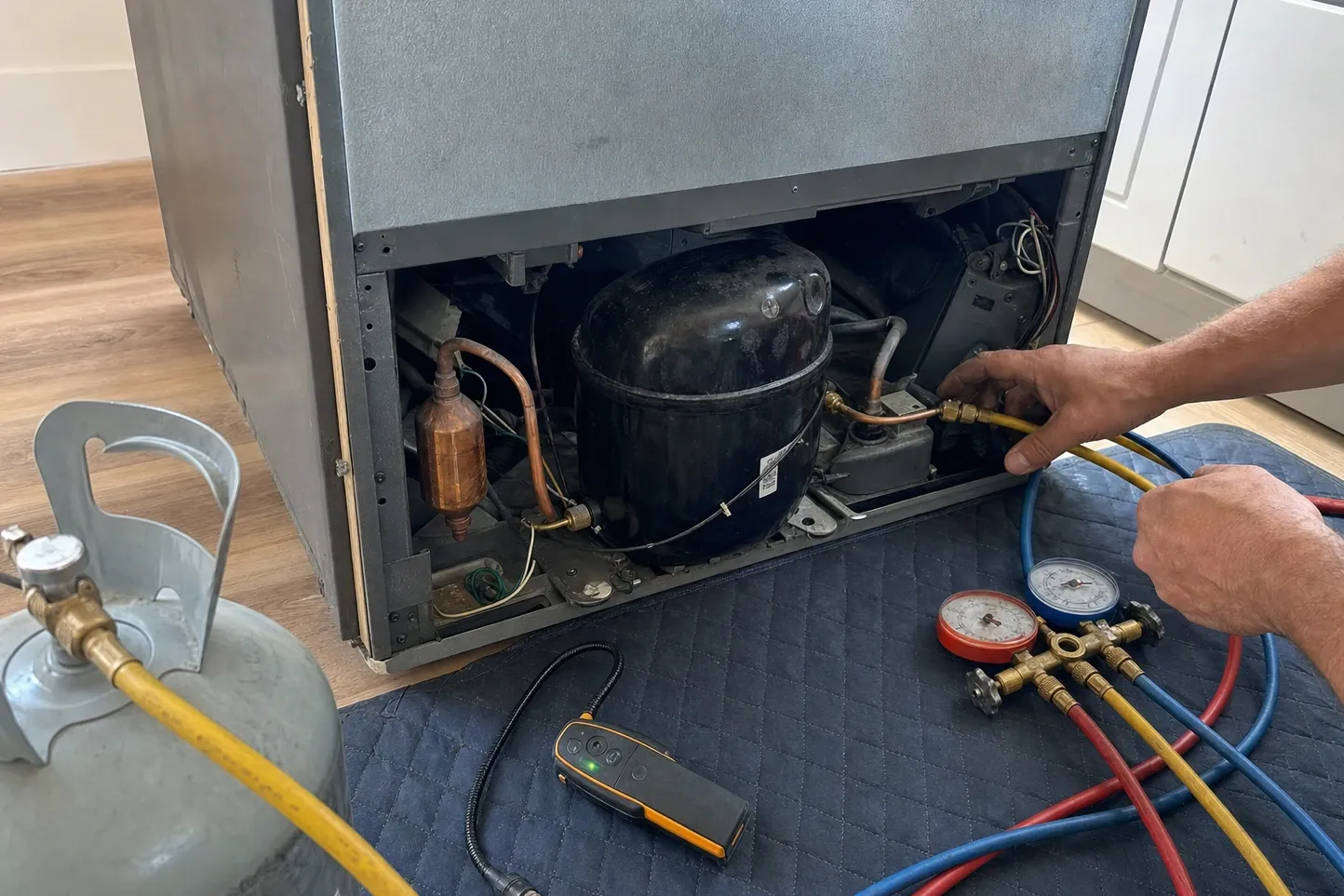
A built-in Sub-Zero rejects its heat through a condenser coil tucked behind the upper or lower grille, and it moves air through that coil with one fan running in a very confined space. That design is quiet, tidy and completely dependent on the coil staying open. In Denver it does not stay open for long.
What actually collects in there
Three things, in this order of nuisance. Fine grit, which arrives on the dry spring wind and gets everywhere in this city whether the windows are open or not. Cottonwood fluff, which is the seasonal one — for a few weeks it drifts through screens, is drawn straight to the only strong airflow at floor or ceiling level in the kitchen, and mats across the coil face like felt. And pet hair, which binds the other two into a blanket that will not shake loose.
The tell is not usually visible from the front. A grille that looks clean can have a coil behind it that is 70 per cent blocked, because the mat forms on the far face where the air enters. That is why so many of these calls arrive as “it just stopped keeping up” from someone who has looked at it and seen nothing wrong.
What a blocked coil does to the cabinet
Refrigeration is a heat pump, and a heat pump that cannot dump its heat does not fail cleanly — it degrades. The sequence is consistent enough to diagnose from a description:
- The compressor runs longer between rests, then eventually stops resting at all.
- The freezer holds for a while, because it has the bigger temperature difference to work with, so the fresh-food side is what drifts up first on a single-system unit.
- The cabinet becomes sensitive to the room. A kitchen that bakes in the afternoon, or a west-facing Highland kitchen in July, shows the fault weeks before a shaded one does.
- The machine compartment runs hot enough to feel through the grille.
None of that is subtle once you know it, and all of it is reversible if it is caught while it is still an airflow problem. What is not reversible is the wear: months of high head pressure is hard on a compressor, and it is the reason a neglected condenser eventually turns into a genuinely expensive repair rather than a housekeeping job.
Telling airflow apart from a real fault
Airflow problems and component failures overlap in symptoms, so here is how we separate them on site — and what you can sensibly check first.
Put your hand near the grille while the unit is running. A working condenser fan moves noticeable warm air. Nothing moving, or a note that rises and falls, points at the fan rather than the coil. Then look at the coil face with a torch. If you can see a grey mat between the fins, you have found at least part of your answer.
Two things argue against airflow being the whole story. First, a freezer that is warm while the fresh-food side is fine — on a paired column or a dual-system built-in, that is the wrong way round for a condenser problem and usually means that circuit’s own evaporator fan, damper or defrost. Second, temperatures that drift back up within days of a clean, which says the sealed system has already lost capacity and wants gauges on it.
What a clean does and does not fix
Pulling the grille, brushing the coil face down and vacuuming the compartment out is genuine maintenance, and on a unit caught early it is the entire repair. Reaching further in is not a home job: the fins bend, the aluminium tubing behind them is thin, and a bent fin field makes the airflow problem permanent. Bending a fin into the tubing is how a maintenance visit becomes a sealed-system repair.
The other half of the job is the drain. Denver air is dry enough that a partly blocked drain does not announce itself as frost the way it does in a wet climate — the water gets away as vapour until the blockage is complete, and then it appears as meltwater under the crisper drawers with no warning. The dust that blocks the coil is the same dust that blocks the drain, so both get looked at on the same visit.
When it is worth having someone out
Call when the cabinet is out of range and has not come back after the grille has been cleared, when the compressor never rests, when the machine compartment is hot enough to be unpleasant to touch, or when you have meltwater rather than frost. Those four cover almost every condenser-related call we take across Cherry Creek, Washington Park, Highland and Capitol Hill.
What a visit gets you is measurement rather than opinion: temperatures at both circuits, pressures where they matter, the fan and its capacitor checked electrically, and the drain proved clear. The $89 service call covers that assessment, and it comes off the repair if you approve the work. If the answer is “this needed a brush and nothing else”, you get told that too — it is a much better outcome for everyone than a replaced part that was never the problem.
Follow-up questions
How often should a built-in condenser be cleaned in Denver?
Twice a year is realistic on this Front Range dust, and once in late spring is the one that matters most — that is when cottonwood is in the air. A household with a shedding dog or a scrape-off build next door needs it more often than that.
Can I clean the condenser myself?
The accessible part, yes. The grille comes off by hand on most built-ins, and a soft brush plus a vacuum on the visible face of the coil is safe and useful. Do not push a brush deep into the fins or touch the aluminium tubing, and leave anything behind the fan bracket alone.
My cabinet went back to normal after a clean. Is that the end of it?
Usually, if you caught it early. What it does not undo is time already spent running at high head pressure. If temperatures drift again within a few weeks, or the compressor runs without ever resting, the fault has moved past airflow and wants measuring.