Freezer Repair · Denver
Frost sheeting the back of a Sub-Zero freezer: reading the defrost system
Ice building across the rear panel of a built-in freezer is a defrost fault, not a sign the freezer is working hard. How to tell a failed heater from a blocked drain or a leaking gasket, and what is worth checking before the drawer stops closing.
Written by
Tobias Reinhardt
Refrigeration technician — doors, gaskets and cabinet fit · 9 years in the trade
EPA 608 certified
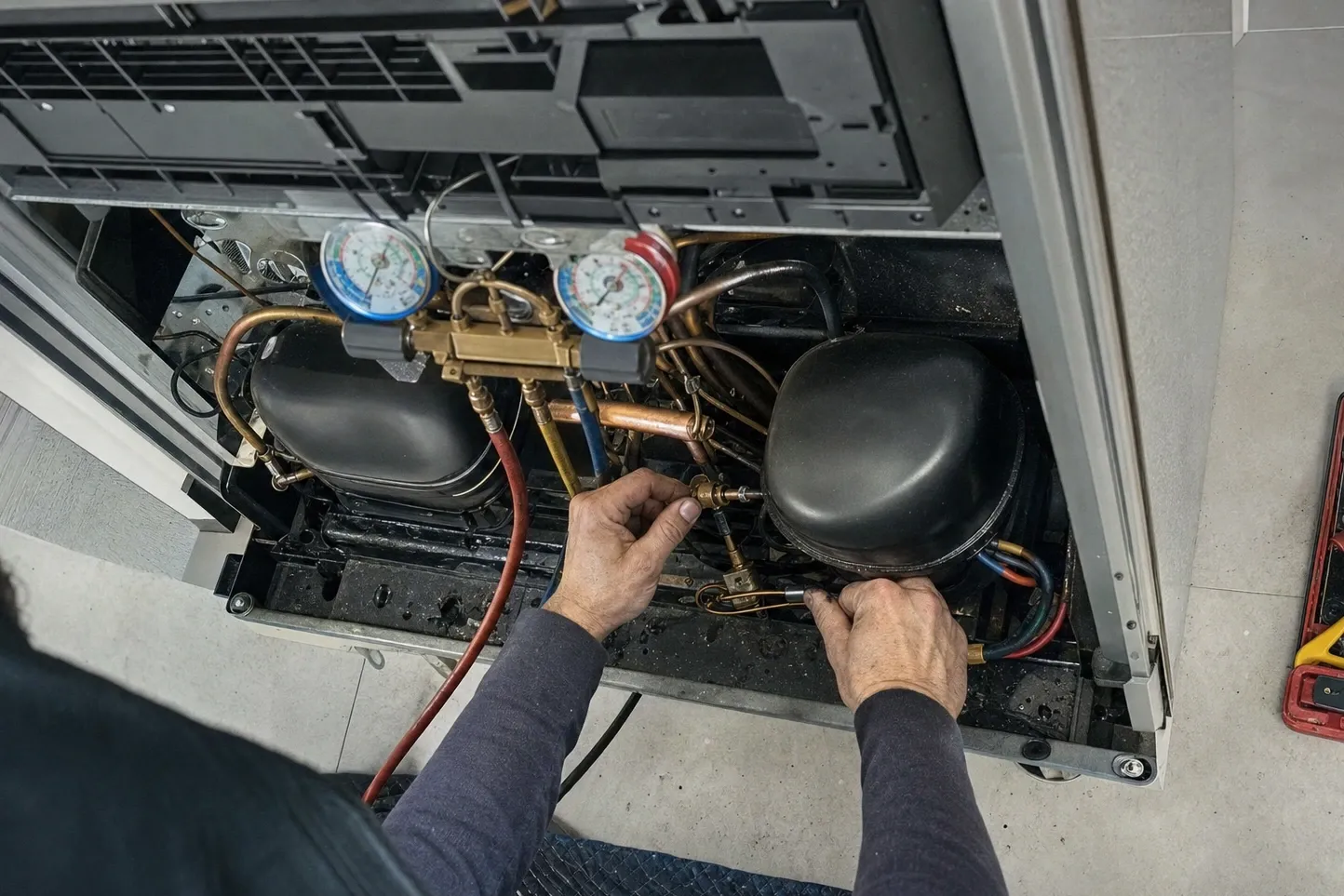
A built-in freezer is designed to be dry inside. Air is chilled over an evaporator behind the rear panel, moisture freezes onto that evaporator rather than onto your food, and several times a day a heater melts what has collected and sends it down a drain to evaporate near the compressor. When you can see ice, that cycle has broken somewhere — and where the ice sits tells you a good deal about which part.
Read the ice before you touch anything
Three patterns, three different jobs.
Ice as a clear sheet across the rear panel, thickest at the top, is classic failed defrost. Water is being made and refrozen in place because the melt is not happening or not draining.
Ice on the floor of the cabinet or under a drawer, with the rear panel relatively clean, points at the drain rather than the heater. The melt is happening on schedule and then refreezing on the way out, usually at a drain heater that has quit or in a line packed with dust.
Frost as a soft, even fur on the walls and on the food, worst near the front, is a sealing problem. Humid room air is getting in past a gasket or a door that no longer pulls itself shut, and the evaporator is condensing it out as fast as it arrives.
Why dry air makes this harder to spot in Denver
Denver works against you here. In a humid climate a partly blocked drain fills the cabinet with frost quickly and obviously. On the Front Range there is often not enough moisture in the room air to make an obvious mess, so the fault stays quiet for weeks and then presents as one of two odd symptoms: a drawer that will not close, or meltwater somewhere it should not be. Neither reads as “defrost problem” to a homeowner, which is why the ice is usually well established by the time we see it.
The other local twist is the power. A summer hail storm that takes the block out for twenty minutes will restart a unit into a defrost cycle it was not expecting, and a marginal heater or sensor tends to reveal itself in the week after that rather than on the day.
What we check, in order
- The heater itself. An open circuit is measurable in a minute and is the most common single cause. It either passes current or it does not, so this is a definite answer rather than an opinion.
- The sensor or thermistor telling the board when to defrost. A drifted sensor is the sly one: the heater is fine, the board is fine, and the cycle simply never gets asked for. The reading is compared against actual cabinet temperature, and a disagreement of a few degrees is enough to explain everything.
- The drain path. Blown out, then proved. Water goes where it is supposed to go in front of you, or the fault is still there.
- The drain heater, on units that have one, for the ice-on-the-floor pattern.
- The gasket and the door. Along its whole length, not just at the handle end: a split or a corner lifted out of line lets a surprising amount of air in. On built-ins that use a vacuum seal, a door that has stopped pulling itself shut is its own fault to chase and often comes down to a hinge that has moved as the house settled — common in the older brick stock around Capitol Hill.
- The evaporator fan. Not a frost cause, but a fan struggling against accumulated ice is often what people actually notice first, and it needs checking before the panel goes back.
What is worth doing yourself
Empty it and defrost it fully if you are waiting for a visit — several hours with the drawer open and the unit off, towels down. Do not attack the ice with a screwdriver or a hair dryer at close range; the evaporator tubing is soft aluminium and the panel is plastic that goes brittle at freezer temperatures. A punctured evaporator turns a straightforward heater replacement into a sealed-system job.
Then check the gasket by eye and by feel along its entire run, and look at the floor of the cabinet after everything has thawed. If the ice comes back on the same timescale, you have learned something useful: the fault is in the defrost circuit rather than a one-off from a door left ajar.
When to stop and call
Call when the ice returns after a full manual defrost, when a drawer will not close against the build-up, when there is standing water or ice on the cabinet floor, or when the compartment is holding in the teens rather than near zero. That last one matters more than it sounds — food surviving is not the same as food keeping, and a freezer running ten degrees warm has quietly stopped doing its job.
A visit means the defrost circuit measured rather than guessed at, the drain proved clear with water rather than declared clear, and the panel back on properly. The $89 service call covers the diagnosis across Cherry Creek, Washington Park, Highland and Capitol Hill, and it comes off the repair when you approve the work. Most of these are a single component and one visit — the heaters, sensors and gaskets that fail on these units are parts a technician carries.
Follow-up questions
Is frost inside a freezer normal?
A light rime on the walls of a drawer that gets opened constantly is normal. A sheet of clear ice across the rear panel, or ice on the floor under the drawer, is not — both mean water is present at a time it should not be, which is a defrost or drain problem.
Will defrosting it manually fix the problem?
It buys time, and it is worth doing if you are waiting on a visit — everything out, drawer open, unit off, several hours. It does not repair anything. If the heater, sensor or drain is at fault the ice returns on the same schedule it did before.
Why does the drawer stop closing before anything else goes wrong?
Because ice grows towards the only warm air available, which is the gap at the front. On a freezer drawer the build-up reaches the rails and the gasket before the temperature has drifted far enough for anyone to notice on the display.